原理
測光は光を測定する科学です。天体から放射される光の束や強度を測定することを目的としています。Sirilでは、測光は変光星の光度曲線、太陽系外惑星のトランジット、恒星の掩蔽を分析したり、RGB画像の色を補正したりするのに使われます。
開口測光が使用される方法です。その基本原理は天体の中心からある半径で観測された光束を合計し、同じ領域の空の背景の寄与(半径の内側と外側の間のリングで計算され、逸脱したピクセルを除く)の合計を差し引き、天体の光束だけを残して装置等級を計算することです。これを下図に示します。
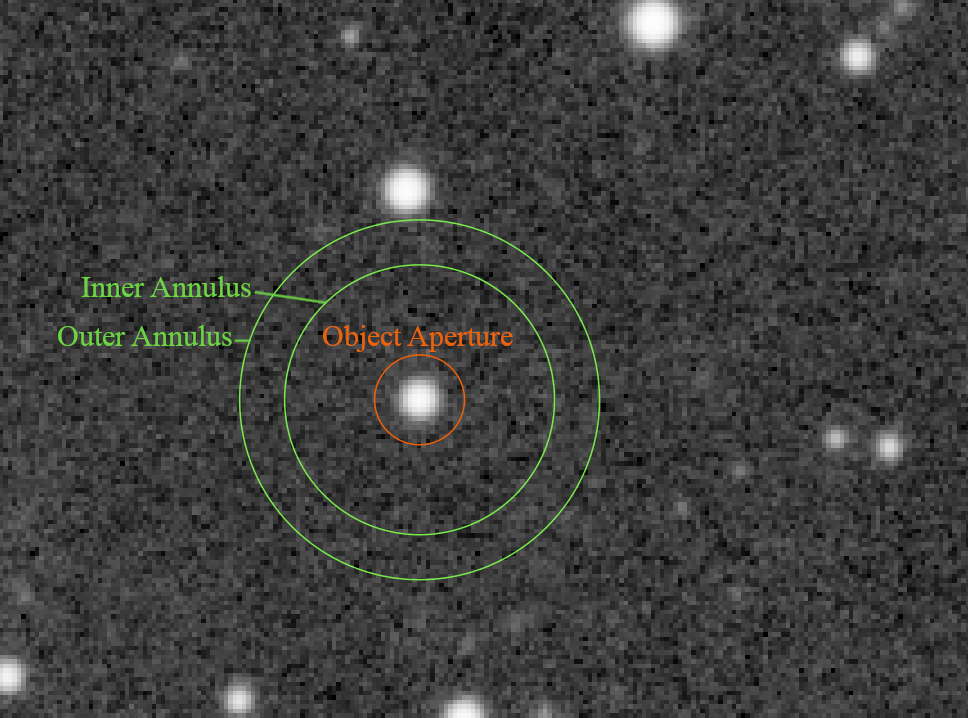
開口測光の円
これらの設定値は設定の 測光 セクション、または setphot コマンドで変更できます。aperture には測定する天体のピクセルをすべて含めることが必要で、annulus は、反対に、そのピクセルを含んではなりません。デフォルトでは、aperture は PSF の FWHM の 2 倍で調整されますが、annulus のサイズは固定されます。これらの値は、与えられたサンプリングに対して調整し、注意深くチェックすべきです。
注釈
以下の文章は、David Motlが作成し、GNU Free Documentation Licenseの下でリリースされた、優れたMuniPackソフトウェアドキュメントの一部を抜粋し、修正したものです。そのソースは ここ で入手可能です。
天体の等級を測る
天体の周りの小さな領域 A のピクセルの合計 S は、天体の正味の強度 I と背景の強度 \(B\cdot A\) の合計です:
S と B の値は元のフレームから得られ、面積 A は半径 r の円の面積として決定されます。このとき、r はピクセル単位での開口サイズです。その場合には、ADU内の天体の正味の強度 I を計算するのは簡単です:
正味の強度 I が観測された光束 F に比例すると仮定すると、ポグソンの法則を利用して天体の見かけの等級 m を導き出すことができます:
測定誤差を推定する
天体の生の装置輝度を導いたら、その標準誤差を推定してみます。最初に、標準誤差とその伝播に適用されるいくつかの一般的なルールを思い出しましょう。これは、不確かな値 X の関数 f を介した誤差伝播の一般的なルールです:
この一般的なルールを用いて、誤差伝播の2つの法則を導きます。最初のケースでは、不確かな値 X は定数 a で乗算され、定数オフセット b によってシフトされます。この法則は乗算のみ、またはオフセットのみが発生する場合にも使用できます。
2番目の法則は、不確かな値 X の対数の誤差を定義します:
ここでの log 関数は自然対数であり、ポグソンの公式(上記参照)は10を底とする対数を組み込んでいることに注意してください。次の式は、この違いに対処するのに役立ちます:
この2つの方程式を合わせると以下のようになります:
2つの無相関の不確定変数 X と Y がある場合、それらの和の分散はそれらの分散の和であり、この式はBienayméの公式として知られています。
この公式から標本平均の標準誤差も導出できます。母集団の標準誤差の標本ベースの推定値 s を持つ確率変数 X の N 個の測定値がある場合、母集団平均の標本平均推定値の標準誤差は次のようになります
Armed with this knowledge, we can start thinking about the estimation of standard error of object brightness. We will consider the following three sources of uncertainty: (1) random noise inside the star aperture that includes the thermal noise of the detector, read-out noise of the signal amplifier and the analog-to-digital converter, (2) Poisson statistics of counting of discreet events (photons incident on a detector) that occur during a fixed period of time and (3) the error of estimation of mean sky level.
For the estimation of mean sky level, we have used the robust mean algorithm. It allows to estimate its sample variance \(\sigma_{pxl}^2\). This is a pixel-based variance and because we have summed together A pixels in the star aperture, the Bienaymé formula applies, the sum S is a sum of A uncorrelated random variables, each of which has variance \(\sigma_{pxl}^2\). For the variance of the first source of error we get:
where A is a number of pixels in the star aperture.
From Poisson statistics we can derive a variance that occur due to counting of discreet events, photons incident on a detector, that occur during a fixed period of time, the exposure. We will again need to use the gain p of the detector to convert a intensity in ADU to a number of photons. If the measured net intensity of an object is I we compute the mean number of photons \(\lambda\) as
注釈
The value of the gain p of the detector can be changed in the 測光 section of Siril's preferences
Then, the variance of intensity due to Poisson statistics is equal to its mean value.
The variance is in photons, we have to convert it back to ADU to get the variance in units \(ADU^2\).
We have derived the sky level as a sample mean of pixel population in the sky annulus. Because each pixel in the annulus has variance \(\sigma_{pxl}^2\), the variance of sample mean is
where \(n_{sky}\) is the number of pixels in sky annulus.
From equation (9) we compute the variance of object's intensity as
Note, that in equation (2) the sky level is multiplied by A, so we have to multiply its variance by \(A^2\) - see the equation (16). Now, we use the law of error propagation for the logarithm adopted to match the formula of the Pogson's law.
Putting equations (17) and (16) together, we can derive the standard error of the object's brightness in magnitudes as